

Diego Romero’s Path: From El Patojismo to PhD
As a teenager, Diego Romero lugged his guitar to his uncle’s patio to practice with his band, unaware that those backyard sessions would unfold beside the beginnings of something far larger: Juan Pablo Romero Fuentes’s grassroots school movement that grew from that small patio into Los Patojos and later El Patojismo.
“I had a band, and we were really bad, practicing in what was the patio of the old school in Pablo’s house,” Diego recalls.
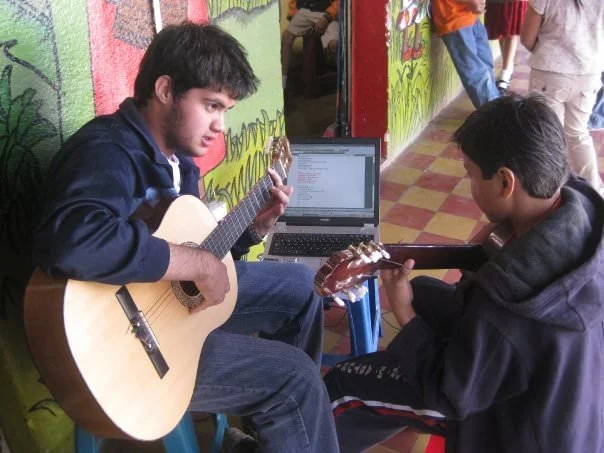
Diego Romero as a teenager in Guatemala
His music may have been a work in progress, but his timing was perfect: he was among the first group of students to benefit from what would grow into a fully accredited elementary through high school in Jocotenango, Guatemala, supported by JustWorld International and other partners for nearly two decades. At the time, Juan Pablo hadn’t yet become a CNN Hero for his work offering a brighter future to thousands of children, but the vision was forming.
“We were essentially the first group that started everything,” Diego says. “It was this idea of young people who are passionate about something, creating a space for them to go beyond what they are doing.”
Twenty years later, Diego holds a PhD in political science from Duke University and is an assistant professor in the Lyndon B. Johnson School of Public Affairs at the University of Texas in Austin, where he lives with his wife and two cats. He previously worked as assistant professor at Utah State University.

Diego Romero today at his desk at the University of Texas in Austin.
“Diego is a true ‘Dream and idea in action’ excellent example of commitment, effort, dedication, dignity and tenacity,” Juan Pablo says. “We are happy and proud of Diego; he is our family pride and one of the most inspiring stories of the project.”
Diego has worked on projects in Africa, Latin America and Ukraine. “I do a lot of research and some teaching on governance, accountability and corruption in developing countries,” he says. “As long as there’s an interesting research question, I will go there.”
All because of an encounter that started on that patio.
A Beautiful Moment
As Juan Pablo expanded his offerings, volunteers began arriving, most of whom spoke English and were working to improve their Spanish.
“Pablo encouraged us to learn things we were not inclined to,” Diego says. “I didn’t really want to learn the language, but we figured out communication; they learned more Spanish, and we learned more English.”
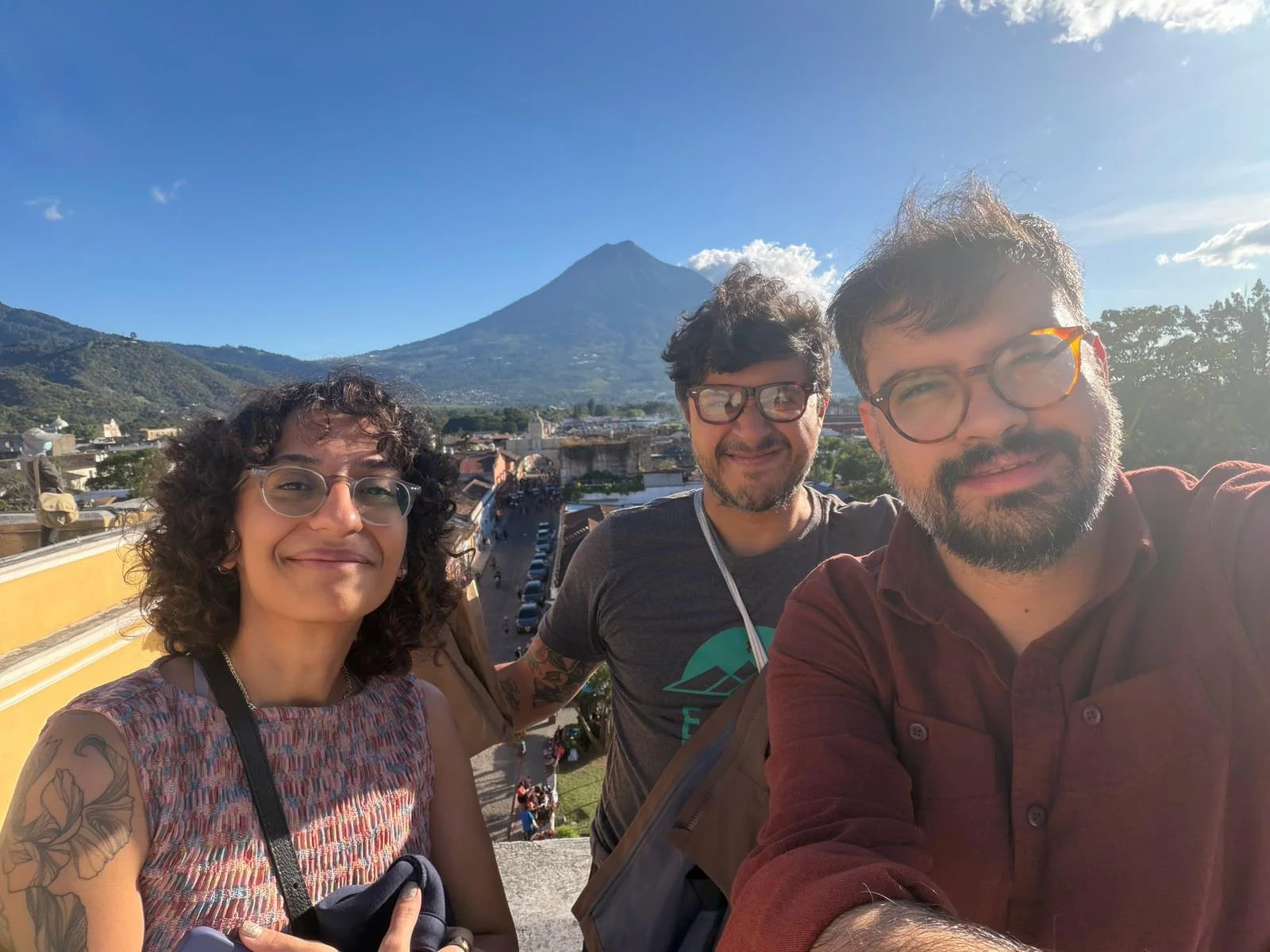
Diego (right) with his wife, Ferda, and Juan Pablo
Just before Diego graduated from high school, one of those volunteers and her family helped him find scholarships to attend college in the United States.
“That was a beautiful moment,” he says. “That’s perhaps the most life-changing event that happened to me.”
One afternoon a week, Diego was joining activities with some of Juan Pablo’s students from a nearby Catholic school. “Pablo would prepare discussion questions and activities. They were developing modules, and we had a syllabus of things to do during a particular time, projects, and he soon extended this to kids as well [as teenagers].”
From that first group, Diego remains in touch with a friend who attended university in Guatemala, earned his master’s degree in Spain, and went on to work at the United Nations. Another student became a chef in Antigua; still others became accountants.
But higher education isn’t the only marker of success for El Patojismo graduates. More importantly, Diego says, the vision is about having the space to discover your strengths and passions, whatever they are.
“Focus on things you’re really good at, and flourish in that,” he says.
Exposure to Another World
Today, he says, the school offers programs to a higher risk community. “The neighborhoods west of the school, more dangerous neighborhoods, and youth who wouldn’t normally finish high school, where teen pregnancy rates are high and most people make a living though informal employment,” he says.
At El Patojismo, those students discover academics but also arts, sports, communications, coding, technology, culinary arts, business skills and much more.
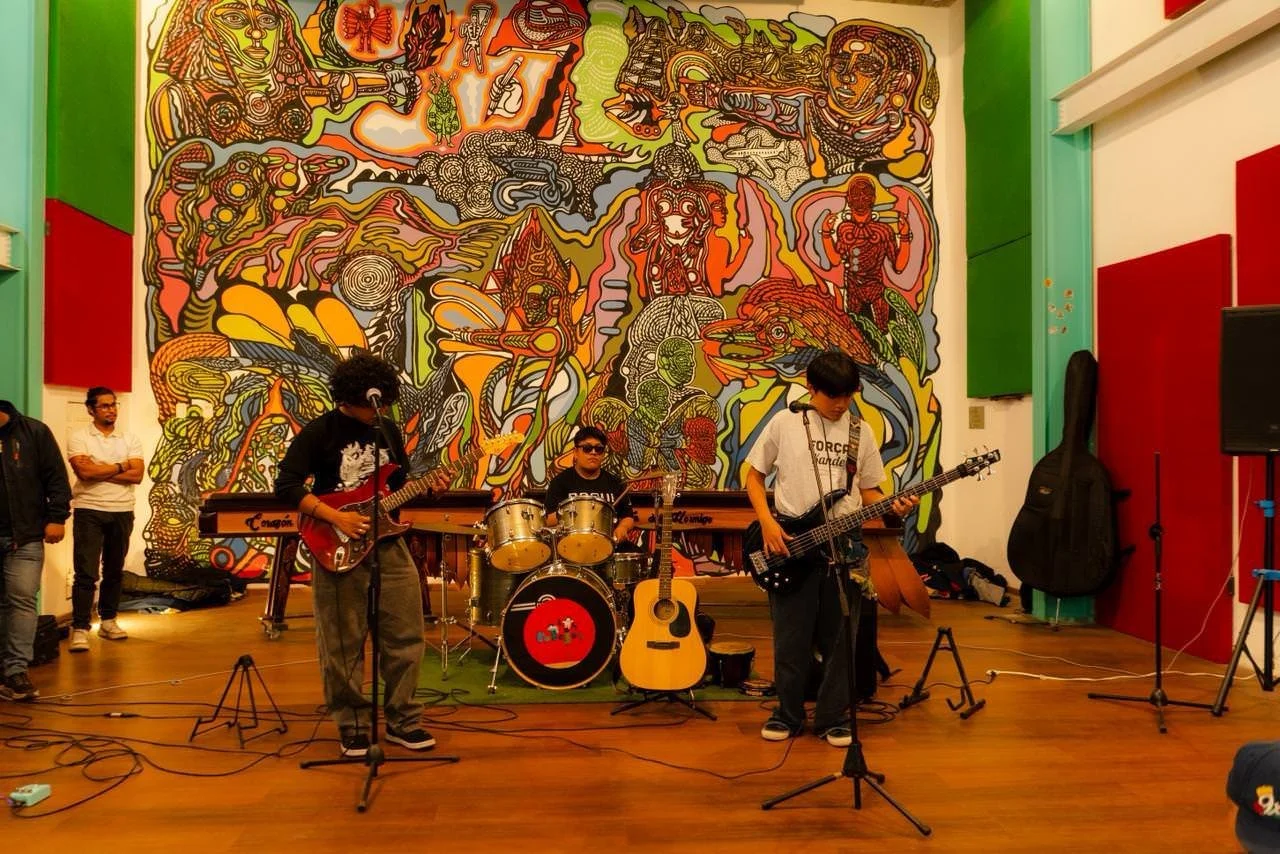
Students at El Patojismo today, long after Diego left, carrying on the tradition of learning and dreaming.
“Were Los Patojos not there, I don’t think the average kid in Jocotenango could say, ‘I want to be a musician’ or ‘I want to create a business,’ ” Diego says.
Although Antigua is only 15 minutes by car from Jocotenango, the towns are of two different worlds, Diego adds. “Antigua is the world of fancy people, big money and cars and fancy restaurants, and Jocotenango is not. So yes, you may go to Antigua for Holy Week or to the market, and you are exposed to arts or music, but growing up in Jocotenango, you don’t think you can aspire to those things because you’re not born in that part of the country. This school says, ‘That could be you; you don’t need to feel inferior. You can do those things.’”
A central tenet of El Patojismo has been the importance of conversations. “Figuring out what your ideas are in conversation with other people is not something public education does in Guatemala,” Diego says. “You’re just reading something and being tested on it.”
He recalls heated discussions about a range of topics: the history of the country, politics. “There was no topic that wasn’t on the table, and the profession I’m in is a constant debate of ideas, and that really helped me prepare,” he says. “You learn you’re not always right. You listen and learn from other people.”
While Diego left his native country, El Patojismo encourages finding and building opportunities within Guatemala.
“In Guatemala, there is one public university and only a couple of good private universities, and you can not make a living only in academia. Instead, you must work on consulting or something else and see academia as a side job,” Diego says. “In the U.S., you have the freedom to do the research you want, and I have a position that allows me to reach out to people who are important in government and share knowledge. My dreams I could not realize there, but for people starting their own business, they can do it [in Guatemala].”
Making an Impact
Last year Diego published a chapter of his thesis, an accomplishment he’s particularly proud of.
“It’s a piece on capacity and corruption that I think has knowledge that can be applied broadly to governments,” he says. “The traditional logic is if you have people with degrees, you shouldn’t have corruption. But the problem is that this recommendation misses the point. You need to consider the system that hires these people, if it rewards loyalty over capability, then the incentive is to put skills to the use of whoever appoints them. In Guatemala municipalities, hiring is done at the mayor’s pleasure, and every time there’s a new mayor, they hire a bunch of new people. As a result, even when they hire capable people based on their academic accomplishments, they are responsible to a political boss and must follow all of their requests. Then, if you get a corrupt mayor, you’ll have corruption that’s hidden even better, as more capable employees are put to the task.”
Diego shared the paper with Guatemala’s Minister of Finance on X. “The current government is trying to curtail corruption. I think the Minister did read it, and I want to believe that I may have contributed a little to his and the government’s efforts,” he says. “I hope to have an effect down the line on the policies in my country even if indirectly. If I had stayed in Guatemala, I wouldn’t have been able to do that. It took five years of training on mastering statistical methods, and I needed the platform that the University of Austin or Utah or Duke has given me, and it all goes back to having met that one volunteer.”
Diego continues to donate to the school when he can as he works to contribute to systemic change in Guatemala and elsewhere.
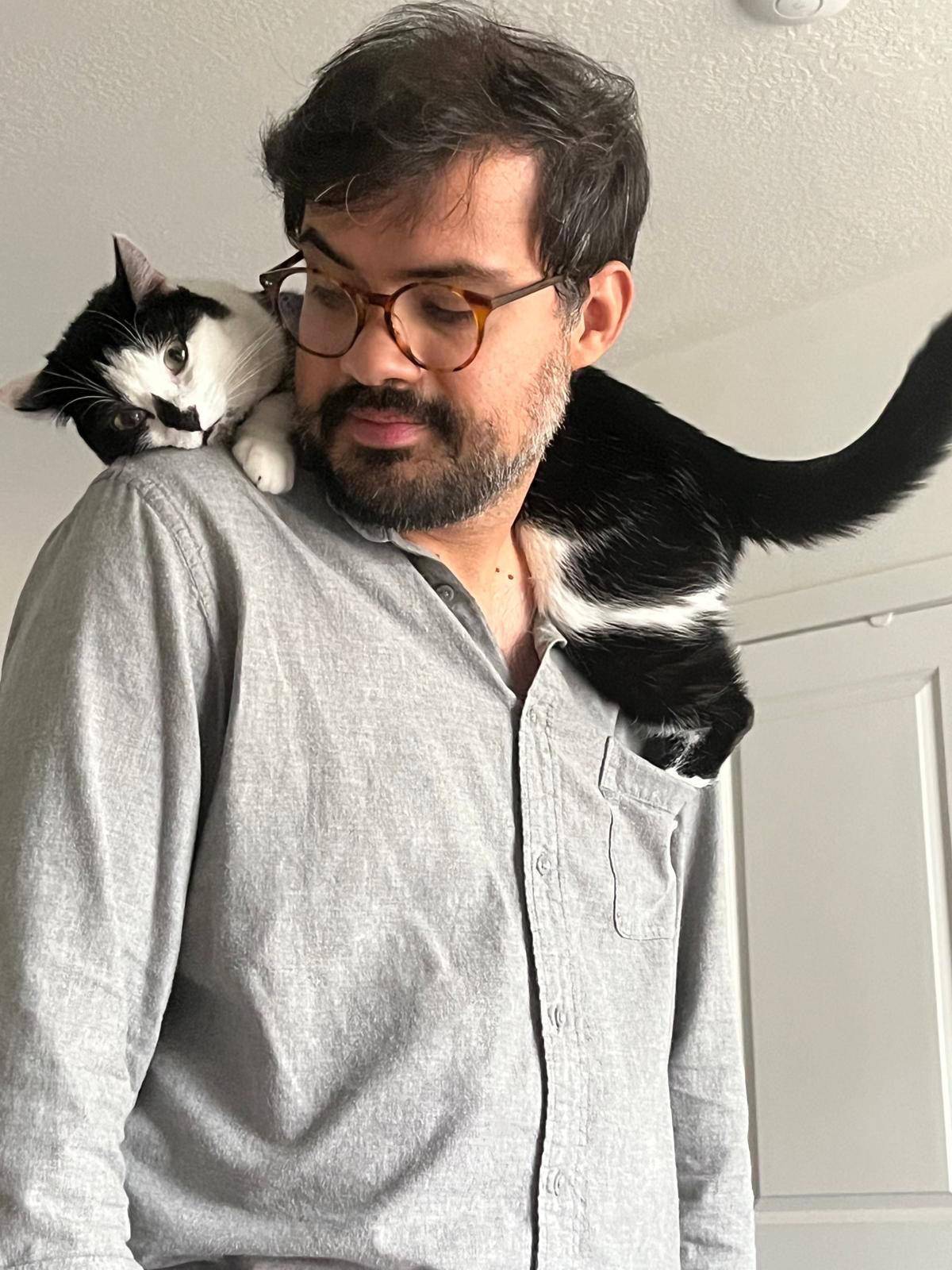
Diego today with one of his cats.
“Diego is a wonderful example of perseverance and discipline thanks to his intellect, talents, audacity, and creativity,” Juan Pablo says. “His profound curiosity to find answers led him to understand his country and the world. From childhood, surrounded by flowers, trees, and the encyclopedias of my father, his grandfather, he began to show himself to be different, authentic and advanced. Thanks to his character, his constant pursuit of knowledge, and the opportunities he had in the early years of our project, Diego developed autonomously and with discipline until he achieved his goal: to study, graduate and work at one of the most prestigious universities in the world.”
Diego is proof that even in its earliest stages, El Patojismo was changing lives for its young students. “For all of [the students in my group], life didn’t happen to them,” he says. “They took life in their hands.”
Thanks to the support of donors like you, El Patojismo is offering more opportunities than ever to its graduates who, like Diego, are embarking on trajectories they would never have imagined without the school.